Getting to the wall safely
A stairwell wall can run two stories with a staircase beneath it, which means there is no flat floor to set a ladder on. The usual answer is staging: ladders or platforms set at different heights, with planks bridged between them so the painter works from a level surface instead of leaning off a rung.
Reach is only half of it. Paint on a tall wall has to stay wet along its whole length while you work down from the top, so the crew needs room to move sideways without stopping. Good staging is what lets one person roll a full height strip without a break.
Cutting in at the ceiling line
Where a tall wall meets a high ceiling, the cut-in line is the first thing your eye finds. A wobble of an eighth of an inch is easy to see from the floor because the line runs so far. Painters get a straight edge by loading the brush correctly, setting the angle against the corner, and working in short, steady pulls.
Ceilings that are textured or slightly wavy make this harder, since the paint wants to creep. A light touch and a clean, nearly dry brush keep the edge crisp. Tape is useful on delicate surfaces, but on an old plaster ceiling it can lift paint, so the choice depends on what is actually up there.
This is the kind of detail Rob cares about. His mindset is do it right even if it is painful, and a ceiling line is where that shows.
Lap marks, accent walls and the big colour
Lap marks are the faint stripes you see when fresh paint overlaps paint that has already started to dry. On a tall wall they show up in raking light from a window or a stairwell lamp. The fix is rhythm: keep a wet edge, roll in full-height sections, and finish a wall before taking a break.
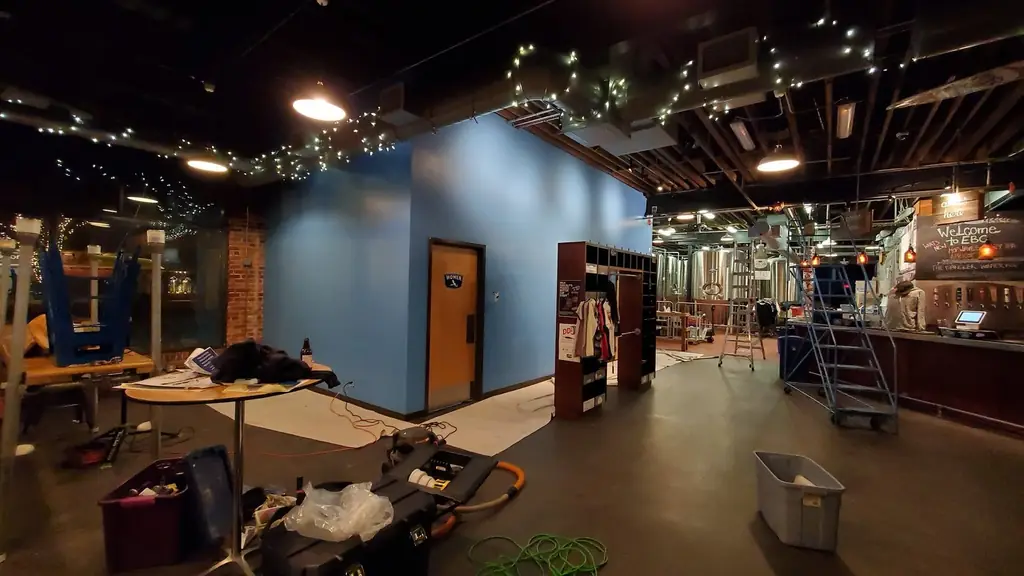
Accent walls are the other thing this page covers. The Excelsior Brewing taproom got a deep blue accent wall, a dark room where the colour had to read clearly under low light. Big colour on a single wall works when the edges are sharp, which brings the story right back to the cut-in line.
If you have a stairwell or a vaulted room somewhere in the Twin Cities, call Rob at (612) 445-4023 and he will look at how it can be reached before he quotes it.