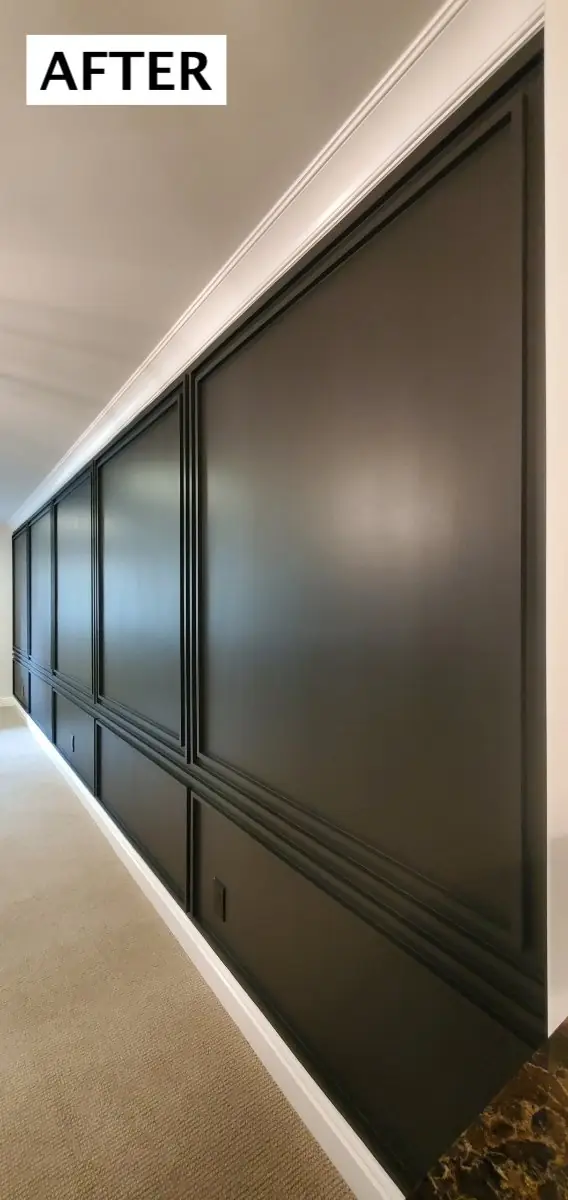
Gaps and nail holes come first
Trim is only as good as what is underneath it. Old baseboards usually have a hairline gap along the top where they meet the wall, and every nail that ever held them leaves a dimple. Paint alone will not hide either one. A bead of paintable caulk closes the gap, and spackle fills the holes, and both have to be dry and sanded flush before anything glossy goes over them.
Skipping this step is the most common reason trim looks cheap. The colour is fine, but the shadow line along the top of the board tells you nobody sealed it.
Sand between coats, and use an enamel
Trim takes a beating from vacuums, shoes and window cranks, so it wants a harder finish than the wall. That usually means a trim enamel, in a satin or semi-gloss sheen, which cleans easily and resists scuffs. The tradeoff is that a glossy surface shows every flaw, which is why the sanding matters so much.
Between coats, a light pass with fine sandpaper knocks down dust and brush marks and gives the next coat something to hold. It is slow, tedious work, and it is the difference between a surface that feels smooth under your thumb and one that feels gritty.
Rob works on the principle that doing it right even if it hurts is cheaper than doing it twice, and trim is where that pays off in plain sight.
The line between wall and trim
Every trim job comes down to one edge: the line where the wall colour stops and the trim colour starts. A good painter cuts that line freehand with a steady brush, or tapes it on delicate walls and pulls the tape while the paint is still slightly tacky so it does not lift. Either way the line should look drawn, not dabbed.
A dark wall with white trim shows how much this matters. When a deep green wall meets a crisp white crown and baseboard, the eye goes straight to that border, and a clean border makes the whole room look expensive.
If you have window casings, baseboards or crown molding in the Twin Cities that need attention, call Rob at (612) 445-4023 and describe what you have.