Painting High Ceilings, Tall Walls, Stairwells and Trim
Height changes the job. So does trim, which gets its own finish for a reason.
October 27, 2026 · 4 min read
A room with a twelve-foot ceiling doesn't just have more paint on the wall. It has a different set of problems: how to reach the top, how to keep a clean edge forty inches over your head, how to light the work so you can see what you're doing. Stairwells add awkward floors and angles. Trim adds its own rules. Here's how a careful painter handles each.
Reaching tall walls
The first question on any tall wall is access. A regular stepladder only goes so far, and stretching from the top rung is how bad edges and bad falls happen. Taller rooms call for extension ladders, a rolling platform, or scaffold planks, depending on the space. In a stairwell, where the floor steps down, the setup often involves a ladder with leg levelers or planks that bridge the steps, so the painter's footing is flat and stable.
Good access matters for the finish as much as for safety. A painter on a steady platform can keep a wet edge going from top to bottom without stopping mid-wall, and that's what prevents lap marks. Long-handled rollers help on the big open areas, but the top and bottom edges still need a person close enough to see them.
Cut-in lines are where you can see craft
Cutting in means painting the edges by brush: where the wall meets the ceiling, around windows and doors, and along trim. A roller can't get there. A straight, steady cut-in line is the clearest sign of a careful painter, and it's the first thing your eye lands on when you walk into a finished room.
On a tall wall the line is harder because the painter is farther from it and can't easily step back to check. Some use tape to keep the line crisp. Others cut it by hand with a good angled brush. Either way, the edge should be sharp and consistent, with no wobble where the wall color wanders onto the ceiling.
Stairwells are their own puzzle
A stairwell is usually the tallest wall in the house, and it comes with a stair stringer cutting diagonally across the bottom, a landing, and sometimes a window up high. Everything about it is awkward: the wall is long, the base is stepped, and there's often a light fixture that's hard to reach. The paint also has to match from the bottom to the top, even though the light is different at each level.
Plan on more prep here, with drop cloths down the whole run of the stairs and taped edges along every tread and skirt. Stair treads are slippery enough on their own, and a wet drop cloth makes them worse, so a careful crew uses grippy covers rather than loose plastic.
Why trim gets its own finish
Trim takes the beating in a room. Baseboards get kicked, door casings get grabbed, window sills get wiped and splashed. So trim is almost always painted with a harder, more washable finish than the walls, usually semi-gloss or satin, and it benefits from a bit more sanding and a primer coat beneath it.
A glossier sheen also shows flaws more, which is why trim demands better prep. Cracks in the caulk, dents, and old drips all look bigger under semi-gloss. A good painter fills and sands the trim, caulks the gaps where it meets the wall, and then paints it in thin, even coats so it levels out without brush marks.
The contrast between trim and wall is also part of the look. Crisp white trim against a deep wall color gives a room an outline. That only works if the lines where they meet are clean, which brings us back to cut-in work.
An accent wall at Excelsior Brewing
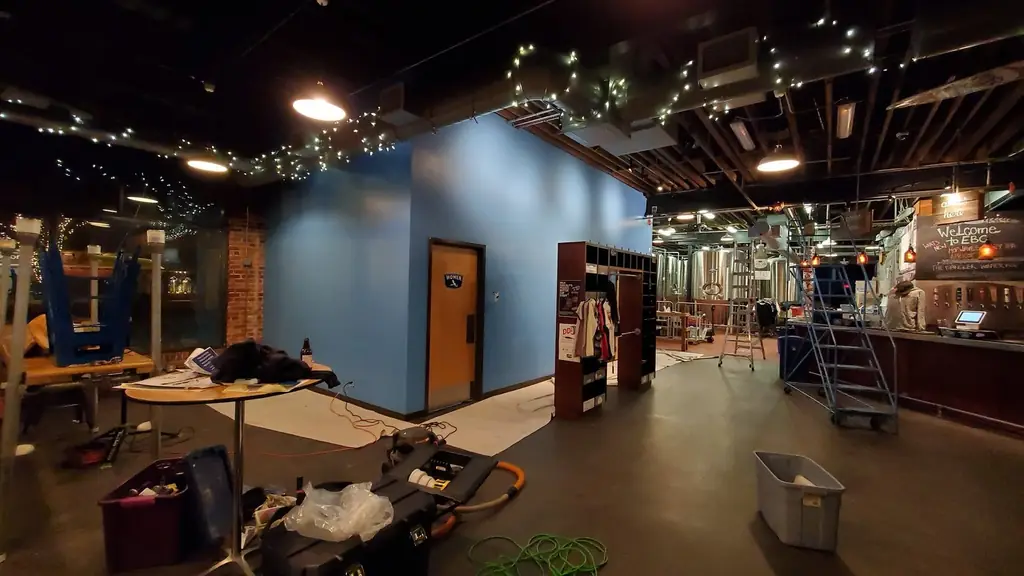
One of Hues Painting's jobs is a blue accent wall in the Excelsior Brewing taproom. An accent wall like that is a good test of everything above. A single bold color against neutral walls shows every uneven edge and every missed spot, and a big, dark color needs steady coverage to look solid instead of streaked. The corners, ceiling line, and edges around fixtures all have to be clean, because the eye goes straight to them.
If you're thinking about an accent wall of your own, pick a wall without a lot of interruptions, and be ready for strong colors to take extra coats. Dark and saturated shades usually need a tinted primer underneath so the color builds up evenly.
A sensible order of work
The order matters more than people expect, because every step can mess up the last one. The usual sequence works from the top down, so drips fall onto surfaces that haven't been finished yet.
- Cover floors and stairs, then repair and sand any damaged walls and trim.
- Prime the repairs and any bare spots.
- Paint the ceiling first, since drips and roller spatter land below.
- Paint the walls, cutting in carefully at the ceiling line and trim.
- Paint the trim last, once the walls have dried, for the sharpest finish.
What to look for before you hire
For a tall space, ask how they'll reach the top, and what they'll do about the stairs. Ask what finish they use on trim and why. And look at their work in a place where lines are visible: the edge where a ceiling meets a wall tells you a lot.
Hues Painting covers high ceilings, walls and stairwells as well as floor and window trim, across the Twin Cities, and Rob Fast gives free quotes. See the high ceilings, walls and stairwells page, or call (612) 445-4023.
Hues Painting, (612) 445-4023
Call (612) 445-4023More articles
Popcorn Ceiling Removal and Knock-Down Texture: What the Job Really Involves
What scraping a popcorn ceiling involves, why older ones should be tested first, and what replaces them.
Painting a Fieldstone or Brick Fireplace: What Changes and What to Leave Alone
A painted fireplace looks completely different, and the work is mostly prep and patient brushing.